
Bog Oak Art: Ancient Irish Wood, Timeless Creativity
Here at Druid Heritage Designs, we use bog oak to create a variety of artisinal products, mainly pens and pendants. Bog oak can be used for many other types or art. Imagine creating a work of art from a piece of wood that began growing thousands of years before the artist was born. This is the extraordinary appeal of Irish bog oak, a material that combines natural beauty, ancient history and human creativity.
From intricate Victorian carvings to contemporary abstract sculptures, bog oak has inspired generations of Irish artists. Its rich, dark colours, distinctive grain and remarkable age make it unlike almost any other artistic medium.
A Tradition of Irish Bog Oak Carving
Bog oak art is certainly nothing new. During the 19th century, Ireland developed a thriving industry producing decorative objects from ancient wood recovered from peat bogs.
Craftsmen created everything from elaborate furniture and jewellery to religious ornaments, Celtic crosses and intricately carved figures. Bog oak pieces were exhibited at London's Great Exhibition of 1851 and Dublin's Great Industrial Exhibition of 1853.
The wood was particularly popular for jewellery and souvenirs, often decorated with shamrocks, harps and other Irish symbols. Today, surviving examples are prized by collectors, representing an important chapter in Ireland's artistic heritage.
Modern Irish Bog Oak Sculptors
Contemporary Irish artists have taken bog oak carving in fascinating new directions.
Eibhlín Ní Chongháile, founder of Celtic Roots in County Westmeath, creates sculptures and wearable art from ancient bog wood. Her work celebrates the natural forms of the timber while exploring our relationship with Ireland's landscape and environment.
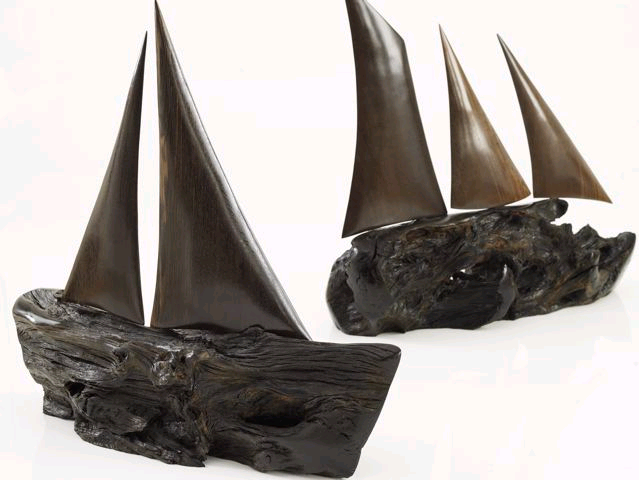
Sailboats by Eibhlín Ní Chongháile. Credit: Jeff Harvey
Larry and Lorcan Harney, based in County Kildare, take a particularly interesting approach. Rather than forcing the wood into predetermined shapes, they allow its natural contours to guide their sculptures. The resulting pieces are collaborations between nature and the artist.
Tony Downey, a sculptor based in County Tipperary, produces carvings of birds, fish, human figures and abstract forms, demonstrating the remarkable versatility of this ancient material.
Other artists, including Michael Casey of County Longford, have helped establish Irish bog oak sculpture internationally, with works displayed in public buildings and private collections around the world.
When Nature Becomes the Artist
Perhaps the most intriguing aspect of bog oak art is that nature has already done much of the creative work.
Thousands of years beneath Ireland's peatlands have transformed ordinary oak into something extraordinary. The interaction of water, minerals and time produces colours ranging from warm brown to almost black.
Twisted roots, unusual grain patterns and natural imperfections can become the defining features of a sculpture.
Unlike working with freshly harvested timber, carving bog oak often means discovering what the wood itself wants to become.
And because no two pieces are identical, every finished creation is genuinely unique.
Bog Oak Art at Druid Heritage Designs
At Druid Heritage Designs, we work on a smaller, more personal scale, but our appreciation for this remarkable material is much the same.
Our handcrafted bog oak pens transform ancient Irish timber into elegant, functional objects intended to be used and treasured for generations.
Our bog oak pendants take a different approach, combining the natural character of ancient wood with Irish leather and sterling silver. Each piece celebrates the beauty of the material while reflecting Ireland's rich cultural heritage.
Whether it's a magnificent sculpture displayed in a gallery or a beautifully crafted pen carried in someone's pocket, the underlying appeal remains the same.
Bog oak art allows us to hold a little piece of Ireland's ancient history in our hands.
And that is something truly special.